The checking tax
Why faster output can still leave people doing the same verification work by hand.
What Must Be Established Before Consequence
A PRACTICAL ARGUMENT ABOUT THE MOMENT BEFORE AN ACTION BECOMES HARD TO REVERSE.
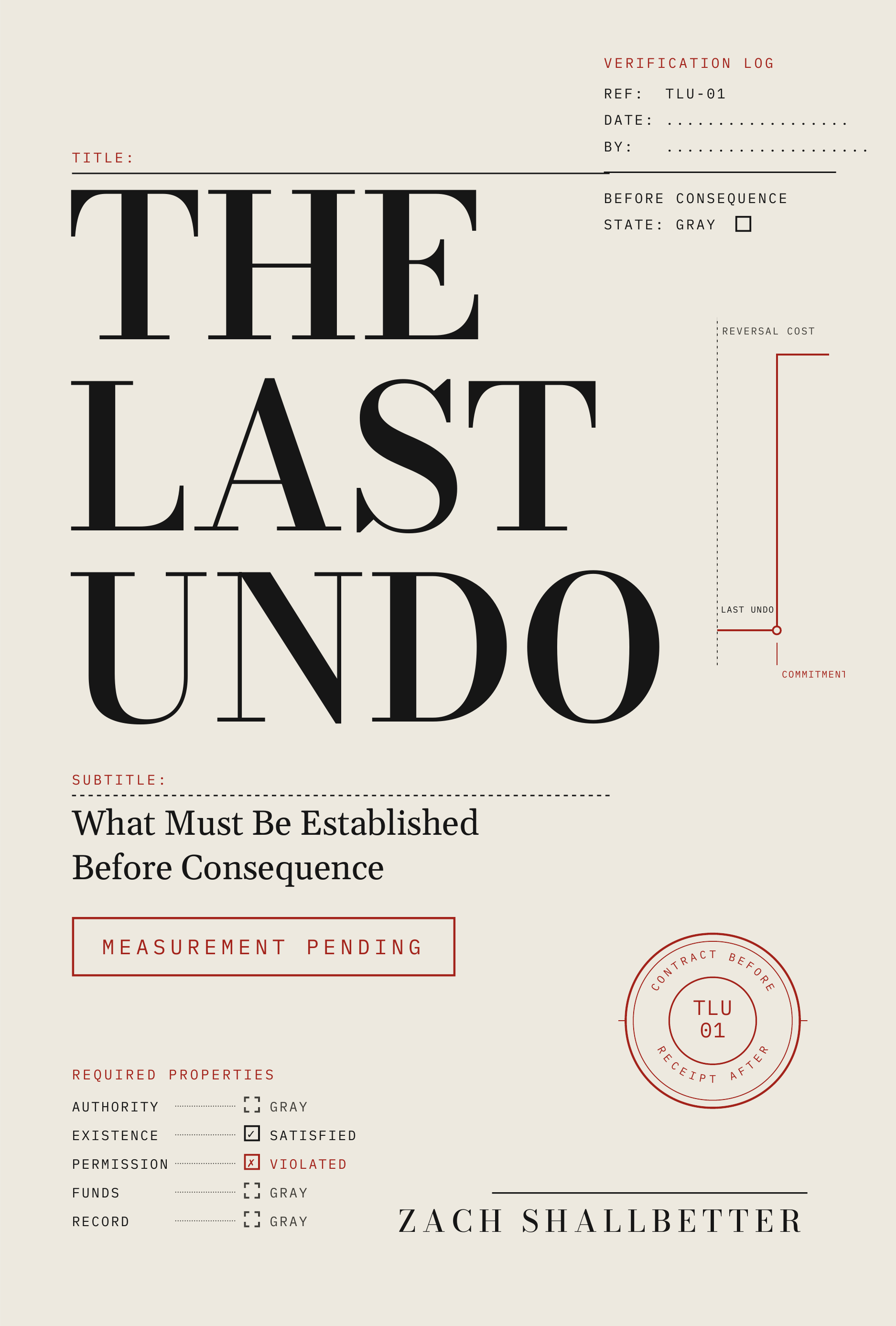 Jacket concept
Some actions have a last undo: the final point at which reversal remains unilateral, cheap, and complete. After that point, correction becomes remediation. The book asks how to find that boundary—and what must be established before crossing it.
AI makes the question urgent, but the subject is broader: how people and machines establish enough about a proposed action before money moves, material is cut, a record is published, a drug is released, or a decision crosses into another system.
Its answer is not a promise of certainty. It is a disciplined way to state what is established, what has failed, and what remains unresolved before a consequential act.
The argument moves from a hidden cost to a testable practice.
Why faster output can still leave people doing the same verification work by hand.
Locate the point where reversal becomes costly, then declare what that particular action requires.
Record what was established, by whom, and on what evidence—without mistaking a record for truth.
Compare like with like, publish the limits, and state what evidence would change the conclusion.
The sequence moves from diagnosis, through design and measurement, to a bounded practice.
CODAAn Old Discipline, a New Material
For builders designing systems that act; operators who check their output; and decision-makers who need to know what a review, approval, or audit actually establishes.
The examples cross technology, aviation, medicine, finance, manufacturing, and institutional practice. The method stays deliberately small: one real commitment, its requirements, its authority, and a record that can travel.
Explore the case archiveA capable agent can still lack permission, sufficient evidence, or a reliable account of what already happened. The book’s practical question is what belongs at the point of commitment—and who is responsible for what remains unresolved.
Try the boundary benchThe book is being prepared for release alongside the Judgment Machines site. Edition, publication date, price, and ordering link will be confirmed together when the publishing and production details are set.
The manuscript does not claim that a receipt proves a decision was right, that every commitment can be cleanly bounded, or that a measured improvement will outweigh its cost. It also names a serious open question: its first publicly reproducible production delta has not yet been measured.