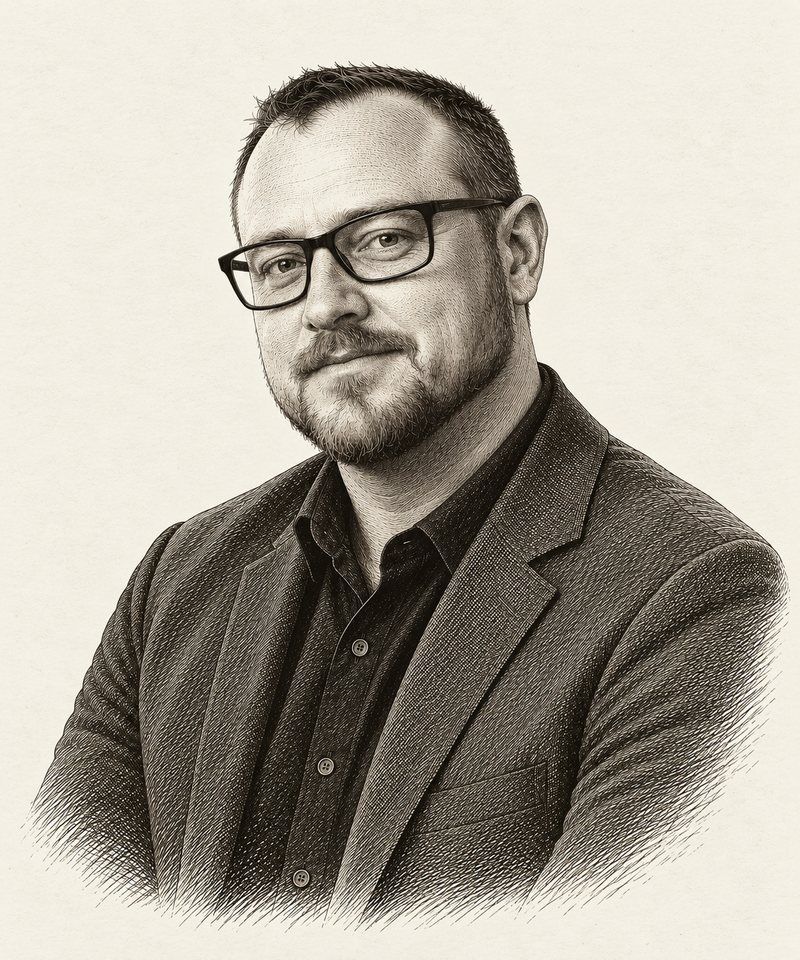
An independent project directed by Zach Shallbetter in Spokane, Washington.
EVERY CLAIM ON THIS PAGE CARRIES ITS STATUS · AUTHOR-STATED CLAIMS ARE MARKED
The work is not to eliminate uncertainty or remove judgment. It is to make inputs, authority, and limits inspectable—and to preserve what remains unresolved.
Judgment Machines publishes the books, builds the instruments, and keeps the records this work requires. It is one person’s project, so this page describes the work behind it: what each thing had to promise, what is not claimed, and how a stranger can check the rest.
PRINCIPLES
Keep the distinctions intact.
Evidence is evidence for a specified claim, under conditions, with limits.
A criterion states what would count; it does not establish that the criterion was satisfied.
Authority may permit action under unresolved conditions; it does not convert the unresolved into fact.
Documentation alone is not answerability. A record must show why the judgment was warranted.
WHERE THE ARGUMENT COMES FROM
A job file that could describe the wrong cut.
From 2018 to 2022 he ran a just-in-time manufacturing line for a hardware company he founded: site, commerce, inventory intake, production, and fulfillment, running largely without a supervising hand. At volume, nobody can read every path. The line had to promise that a job file could not describe a cut the machine should not make.
That problem, capability outrunning permission at the moment of commitment, is the argument of The Last Undo and the reason this institution exists. It took four years and a failed company to learn.
He founded a hardware company and ran its manufacturing line for four years, and co-founded a product studio and ran it for six. His open-source contributions are merged in Rust’s official linter and in Google Labs repositories.
What follows is the work, not a description of the person who did it. Each entry states what the thing had to promise, and what it cost to make that promise hold.
Magnetic, machined, and coated with a process developed in-house because nothing off the shelf survived what players did to it. Funded on Kickstarter at roughly 330 percent of a $30,000 goal, then a seed round of about $500,000.
Had to promise. That the object arriving in a stranger’s house was the object described on a page they read months earlier.
The record deliberately excludes a shipped-units figure. An earlier claim of 25,000 boards is not in the records, and it stays out until a record exists.
Shipped · company closed 20222018–22
System
The line that made them
A just-in-time manufacturing operation covering site, commerce, inventory intake, production, and fulfillment, running largely without a supervising hand. Machines re-engineered in hardware and software, and custom equipment commissioned around the workflow rather than the reverse.
Had to promise. That a job file could not describe a cut the machine should not make. At volume, nobody can read every path.
This is where the argument of The Last Undo comes from.
Dismantled with the company2014–20
Company
Six years of payroll
A product and design studio he co-founded and ran, directing a team of ten and more across design and engineering for clients from startups to the Fortune 500. He owned proposals, scope, delivery cadence, and the mentorship of junior developers.
Had to promise. That people who left other jobs to work there got paid, on a schedule, for six years.
Built with partners, not alone. Three of the four organizations here were.
Wound down2023
Platform
A marketplace for Indigenous art
Built on Next.js, Supabase, and Stripe Connect, with seller verification, customizable storefronts, product customization, and payments. Recommendation, search, and conversational assistance built directly, early in the applied-AI product cycle. Sole delivering engineer.
Had to promise. That a payout reached the right artist for the right work, every time, without anyone checking by hand.
Sole committer throughout. That is contribution evidence, not third-party review.
The with_capacity_zero lint, written against a maintainer-filed issue, revised through review, and merged into Rust’s official linter. It catches a small waste across eight standard collection types using const evaluation, so it fires on a computed zero and stays quiet on a runtime one.
Had to promise. That when a compiler tells a developer something about their code, the statement is true. A false positive in a linter is worse than no linter.
Small in substance. It is here because a stranger can check it in thirty seconds.
Interaction contracts, evidence qualification, decision-making with panels of AI systems, the separation of meaning from expression. Written independently over about eighteen months, each declaring a question it answers and a boundary it refuses to cross. They compose, which was not planned.
Had to promise. That a reader could tell what each one does not claim without reading between any lines.
Not one has been read by anyone outside him. Until that changes they are specifications, not standards.
Unreviewed
WHAT IS NOT CLAIMED
Absences, stated.
A degree. He does not have one.
An exit. Four organizations built, none sold.
A measured delta on production volume. The book asks builders to instrument both windows and publish the gap, and he has not published one. The chapters that depend on it are held until he does.
Two engagements and a filed provisional, withheld while they are unresolved. Their absence is deliberate and is not a gap.
CHECK THE CLAIMS
Every claim, and how to check it.
Externally checkable: a stranger can verify it without asking him. Author-stated: he is the source, and says so.
Claim
How to check it
Status
The lint
rust-lang/rust-clippy PR #17192, merged June 2026, approved by a Clippy team member
Externally checkable
Google Labs contributions
Two merged pull requests, design.md and stitch-skills, 2026
Externally checkable
The marketplace
Repository history; the fine-tuning toolchain is public
No supported count; an earlier figure is deliberately excluded from the record
Author-stated
The line ran largely unsupervised
No external record
Author-stated
The studio, six years, team of ten and more
Registration and public client work
Author-stated
Author-stated claims cluster in one place: the two organizations that no longer operate. They are the oldest claims and the hardest to check, so they are marked rather than blended in. Claims under legal restriction are omitted rather than softened.
STANDING & LIMITS
What this institution can claim.
The manuscript documents work in manufacturing systems and a lint incorporated into Rust’s official linter. The production measurement demanded by the book has not yet been made. No protocol or manuscript on this site has had external review.
SOURCES · THE LAST UNDO, INTRODUCTION v0.8.0 · ABOUT THE AUTHOR v3.1.0 (DRAFT)