ZACH SHALLBETTER / INTRODUCTION
Somewhere right now, a decision is waiting on a sentence. It looks right. Someone checked it. The system approved it. The engineer signed off. We have done this before. The model is confident. I think that is what he wanted. Sentences like these are how work gets released into the world, and most of the time they are enough.
Sometimes one of them is standing exactly where an established fact was supposed to be, and nothing on its surface marks the difference. The difference is the subject of this book: between believing a thing is ready and having established enough to act on it.
The part that is believed but not yet established is what this book calls gray. Everyone already knows how it feels. The drop in your stomach right after you hit send is your brain running the list one second too late. Later chapters give the word an exact coordinate, which property, for which act, on what evidence; the loose form will do for now. One question runs the whole argument: what must be established before this becomes consequential? The question recurs across very different acts. A spacecraft launch. A payment. A diagnosis. A software deploy. A signature. The drive to the airport. A decision made for someone who can no longer decide for themselves. The domains share almost nothing. The problem underneath them is the same.
AI supplies the urgency, not the subject. It made output cheap. It did not make trust cheap. Machines do more of the work, and humans spend more of their time deciding whether to trust the work. The deciding is managed with review queues, confidence scores and feedback buttons. None of them can say what has been established, and none can stop the act. Production is accelerating. Establishment does not accelerate on its own. So the bottleneck moves. The last era of computing asked what a machine could produce. The arriving question is what we are prepared to let that production change. This book's claim is that the question has a location. It sits at a boundary just before the moment a system does something it cannot undo. Once that location is visible, a good deal of old engineering, law, medicine and finance turns out to be circling the same idea. The way through the current mess is already lying around in pieces.
Some consequential acts have a last undo. It is the final point at which the action can still be reversed without asking anyone else, without paying a material price, and completely, including consequences already passed downstream. After that point a correction is no longer an undo. It is remediation. This book is about finding that boundary where it exists, and about the question that belongs there: what must be established before we cross it?
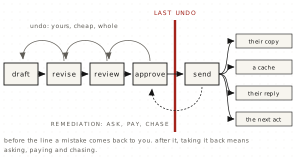
Every commitment requires certain things to be established before it happens. At any moment each of them stands in one of three states: established as satisfied, established as violated, or not yet established either way. The unestablished remainder is gray. Distance from gray is the ground gained against it: the establishment achieved, at a specific commitment, as required properties move out of unresolved. It is not general uncertainty, not model confidence, not accuracy, and not a scalar sitting inside an artifact. The measurement has a coordinate: which commitment, and which list of required things. The same artifact can stand fully established before one action and entirely gray before another, because the two actions require different things.
Gaining that distance is not the same as moving toward approval, and the difference matters enough to state on page one. A required property leaves gray in one of two directions. Established as satisfied, or established as violated. A proposed transfer starts with the account's existence gray; a lookup establishes that it exists. The actor's authority starts gray; the policy engine establishes that they do not have it. Both properties have left gray. The transfer is refused. The system moved entirely out of gray and arrived at no, and that is the architecture working, not failing. Where the question is one of judgment, a named human with the authority to decide it can decide it. Where it is a question of fact that nobody has established, no authority can establish it by deciding; it stays gray until evidence arrives, and until then nothing commits.
Which is why the measurement in this book is called distance from gray and not the elimination of gray. Some properties cannot be established mechanically. Some require human judgment. Some stay unresolved. This is not a book about certainty. It is a book about honesty concerning uncertainty. Know what has been established. Know what has failed. Know what remains unresolved. Know who has the authority to decide when resolution is impossible. And never silently promote one of those states into another because the moment has arrived and somebody needs an answer.
That last kind of knowing is where this argument parts from the shelf it will be filed on. The verdicts at a commitment are pass, fail, or escalate, and the third is not a failure mode. A system that reaches the moment, finds the one property no machine can settle, and hands that one question to a named person with real authority has not broken. It is the architecture working. So is a system that establishes everything and arrives at no. Review, as usually built, says: a person looks at everything, in case. Escalation says: a person with authority decides the one thing only a person can, on the record. The first is furniture. The second is a load-bearing wall, and building it is most of Part II.
The book is not about making AI correct. It is about making systems show what they have established before they act, and about making the remaining gray explicit instead of hiding it behind plausible output. Everything after this is that claim with the evidence attached.
What this book does not claim
It does not promise correctness. A contract, enforced, can make an output well-formed, traceable and refusable. Whether the answer is true is a separate problem, and the book says so where a reader is most likely to hope otherwise. It does not claim that every output needs a guarantee. Where judgment is the point, review is the work. The argument is about the rest: a person repeatedly verifying a property a machine could have established at lower total cost. And it does not try to remove judgment. It tries to hand judgment the one question that needs it, and to record the answer.
What would prove it wrong
This belongs here rather than in an appendix. A reader is entitled to know, before spending an afternoon, that the argument has failure conditions and that they are specific. There are two kinds. The idea itself could be wrong: usable boundaries might not be identifiable in advance, the required lists might not remain stable enough to compare, the whole apparatus might not survive contact with real systems. And the business built on the idea could be wrong even if the idea stands: nobody pays, nobody keeps the receipt, the measured improvement is too small to matter. Chapter 11 takes both sets one at a time, states each at full strength, and says what evidence would settle it. Some of that evidence now exists, and not all of it was flattering.
What I am bringing to it
Twenty years of the same job, in materials that share nothing. A manufacturing line where the commitment was a cutting head entering a sheet. The guarantee was a job file that could not describe the cuts the machine could not make. The line ran that way, in production, for four years. That is my account of it, and the book marks it as mine. A lint merged into Rust's official linter, which moved one check out of a reviewer's head and into the toolchain. It does not certify code as correct. It refuses one shape of mistake. The material changed. The job did not.
That is my authority here, and its limit is specific. These systems were built, shipped, and ran. What has not happened yet is the measurement this book demands of everyone else: the same yardstick, before and after, on production volume, published so a stranger can recompute it. Until that number exists, the book claims no delta of its own. One public comparison exists, and Chapter 8 says what it is and what it is not. Where it says a thing was measured, it names the measurement. Where it was not, it says so.
How the book runs
Four parts, in the order the argument needs them. The condition: the checking tax, when it becomes structural, what gray is, and why the usual response sits at the wrong layer. The seam: where the boundary is, what has to happen there, and how evidence reaches the next person. The measurement: how to tell whether any of it helped, with a number a stranger can recompute. The limits and the practice: what would falsify the argument, how to build one, and what a contract cannot do.
One more thing about the numbers
Every figure with a number in it carries its source, its date and its method, in a note, and the diagrams say when they are sketches. Where a claim rests on my own work rather than on published research, it says so in the sentence, not in the back. Where I believe something and cannot support it, the sentence says that too.
That is not modesty. It is the standard the book sets for itself, and the notes are where a reader holds it to it. An argument that establishment should be checkable, published in a form the reader must take on faith, is self-refuting before the first chapter.
If the whole book had to fit in one sentence, it would be this one. It is about learning what must be established before consequence, and building lives and systems that do not discover it afterward.