Rejected takeoff at V1
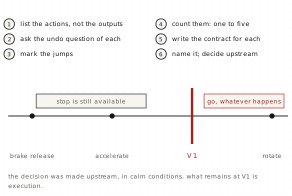
A speed turns the reject-or-continue judgment into a commitment with a shrinking physical margin.
SOURCE STATE · The Last Undo, Chapter 5 draft v0.5.1, note 1; FAA and industry, Pilot Guide to Takeoff Safety, Section 2 of the Takeoff Safety Training Aid, original 1993, data through 2003.
This record reconstructs the argument in its cited manuscript draft. It is not a certified procedure or an independent audit.
Trace the chain.
- Object
- A transport-category aircraft on the takeoff roll.
- Observation
- Airspeed, runway remaining, aircraft condition, and the operating conditions used in runway analysis.
- Distinction
- Before the decision speed, rejecting remains an available action; above it, the stopping margin has been spent.
- Representation
- V1, derived for the aircraft and conditions; the draft distinguishes the operational rule from the regulation’s literal text.
- Criterion
- The operational definition in the cited guide ties V1 to the latest speed at which a reject can begin and the aircraft stop within the runway available.
- Judgment
- Reject or continue under trained operating doctrine. The speed is not a substitute for the crew’s judgment or procedures.
- Authority
- The flight crew, acting under applicable training, procedures, and aircraft-specific data.
- Last undo / seam
- The manuscript treats V1 as the practical decision boundary for this example; the diagram is a general form and not an operating reference.
- Consequence
- A late reject may overrun the runway; a continue decision has its own conditions and risks.
Keep the denominator attached.
The manuscript cites 97 overrun accidents and serious incidents; 55% involved rejects initiated above V1. It explicitly limits that denominator to the accident and incident set, not all rejected takeoffs.
The 55% figure does not measure all rejected takeoffs or establish that a callout was made correctly. The drawing is not to scale and must not be used for flight planning.
SOURCE TRAIL · The Last Undo, Chapter 5, draft v0.5.1, source note 1.